Register for a free accountLost your password?
HOME
PC
PS3
XBOX360
Wii
HANDHELD
OUR RATING:
8
GREAT
TANGIBLES:
Gameplay:
8
Visuals:
8
Audio:
10
Value:
7
Quality:
8
Why you should buy it: If you're looking for a truly unique RTS experience. you'll find a lot to like with the three distinct factions
Why you should rent it: If you're annoyed by micromanagement, then this game might not be for you
UNIQUE RATING:
8
SUGGESTION:
Buy It
Universe at War: Earth Assault
Decrease font size Increase font size

April 21,2008 - Petroglyph Games has had a lot to live up to since their inception in 2003. Founded by Westwood veterans, mentions of Petroglyph quickly bring visions of Mammoth Tanks and other such Command & Conquer icons to mind, and hopes from gamers that such classic RTS quality can be found outside of EA's realm of influence. So far, Petroglyph has been doing a decent job of creating quality RTS titles, with the critically acclaimed release of Star Wars: Empire at War and its expansion in 2006. Now, with Universe at War: Earth Assault, their second full game to be released, Petroglyph can breathe a sigh of relief – Empire at War was no one-hit wonder. Universe at War proves to be an interesting, quality title, though like Petroglyph's first title, is not without a few significant drawbacks.

Universe at War opens with a bang – flying saucers and giant alien walkers are leveling Washington, DC. No sooner than the alien forces begin their assault does a race of sentient robots appear to assist the humans against the alien invasion. The robots, known as the Novus, are the last remnant of a dead alien race which fell prey to the same oppressors that now seek to destroy mankind. Humanity at first regards the Novus as another alien threat, but with time communications are established and humanity learns of the threat they face – an alien race known as the Hierarchy, which goes from planet to planet “strip mining” every world they come across. Of course, the Hierarchy's definition of strip mining includes organic life. The third faction makes a late appearance in the game, revealing themselves as the Masari, an ancient alien race which was nearly annihilated by the Hierarchy. Ironically, the Masari saved the Hierarchy from extinction, but the Hierarchy would have none of the Masari's insistance of being gods, and nearly wiped the Masari out. Reawakened, the remnants of the Masari nation desire to bring a balance to the cosmos once again (and some vengeance on the side). In a completely predictable turn of events, the situation quickly turns into “everyone versus the big, bad guys.” This storyline is ripe with references to old science fiction clichés, and though this is meant to be in homage and is at some points cute or amusing, it will come off as somewhat campy to many gamers.

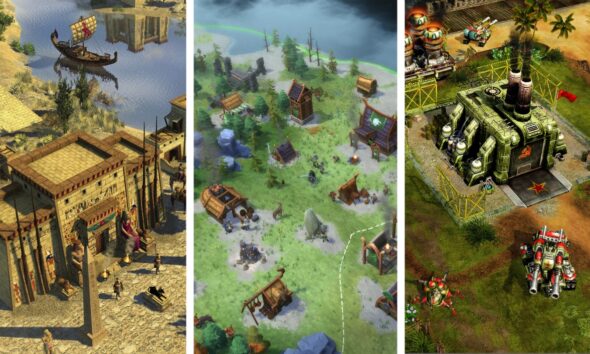
The three factions of Universe at War could not possibly play more differently. Though their general philosophies follow a very typical “fast faction,” “brute force faction,” and “balance faction” approach, the actual methods by which these are achieved are quite unique. The "quick faction", the Novus, relies on a network of buildings to link every structure in their base and abroad. This link allows nearly every unit in the Novus arsenal to quickly travel along the energy lines between structures, allowing nearly instantaneous travel along the battlefield wherever a “flow” network is present. The Novus additionally use a “patch” interface that allows for very quick switches between specific buffs that apply faction-wide. The Masari, the “balance” faction, rely on the use of light and dark modes, which can be switched between on the fly. These modes fundamentally change the behavior of the entire faction, with dark mode being a defensive mode granting additional shielding but reduced firepower, and light mode disabling shielding but allowing aerial assaults and greatly increased firepower. This makes the Masari a tricky race to play, but a potentially deadly one. The Hierarchy is the “brute force” faction of Universe at War, and proves to epitomize the concept by their mobile dual production facility/war machine walkers. They are modular and upgradable, with many different hardpoints that can be upgraded with a huge variety of enhancements – production facilities for advanced units, powerful anti-air platforms, extra armor, weapons range or rate of fire enhancement, self-repair facilities, plasma cannons, mass drivers, giant lasers, and on one walker a deadly, if short-range superweapon. The list hardly ends there, but suffice to say, the walkers can be versatile and deadly, if slow and cumbersome. Destroying either of the production walkers requires taking down nearly all of their hardpoints, so surmounting them is a bit of a task.

Unfortunately, Universe at War has some serious drawbacks. Issues with pathfinding AI hinder the game significantly, though thankfully recent patches have done much to solve this. There are a few annoying bugs that patches have yet to solve. One particularly frustrating one occurred while attempting to evacuate a hero unit – the transport coming in to evacuate him was destroyed while landing, and the hero unit in question ended up completely frozen and helpless on the ground, unable to act. There are also issues with micromanagement. Although the game includes a waypoint system, there is no way to queue up build or attack orders. Additionally, build queues for units are limited to six at a time, making many battles frustrating exercises in battle management constantly interrupted by rapid clicking of unit production orders. There is an interface that allows for quick and easy access to production queues, though one can't help but wonder if it was included to help compensate for a flaw that could have easily been fixed by allowing for larger production queues.

Visually appealing to the last, Universe at War features a wide array of units and structures that are hugely different from one another. They are pretty, they look mean (and ripped right out of a Greek play, War of the Worlds, or an eastern world anime), and they're appealing. Weapon effects are impressive as well. The quality of Universe at War's soundtrack cannot be overstated, and it should be checked out by any gaming or music fan. It's available for free online, and the game itself is almost worth a play due to the wonderful experience the soundtrack combined with the game brings, despite the game's flaws. Given the music is composed by the same man who was in part responsible for the musical tracks to the Command and Conquer series, the musical prowess of the game should come as no great surprise. Sound effects and voice acting are also top-notch, even if the storyline degrades the quality of the voice acting.

Universe at War delivers a unique, fresh gaming experience with factions that have truly innovative concepts sewn intrinsically into them. Unfortunately, it suffers from a few interface issues and bugs that, while not crippling the game, can frequently make it somewhat annoying to play. Though its remarkable faction balance shines in a multiplayer arena, the necessity of a pay-per-month scheme to unlock all online gaming options hinders the game greatly. Universe at War ends up being a remarkable title, held back from being truly great by a few unfortunate fundamental design flaws and another instance of corporate greed taking priority over delivering a quality gaming experience.
UaW features a hero unit based largely on eastern-world "mecha." It has a maneuver which results in "Macrossing," which has become a popular term for giant robots firing ridiculously huge volleys of missiles, a common sight in the "Macross" anime
Games, News, Reviews, Media and More
Previews
Screenshots
Published by: Sega
Developed by: Petroglyph
Genre: Strategy
# of Players: 1-2
ESRB Rating: Teen
Release Date: US: Q4 2007
Our Rating:
Great
Your Rating: N/A
User Rating: N/A
(0 Votes)
Gamer 2.0 Rating: N/A | User Rating: N/A
Gamer 2.0 Rating: 9 | User Rating: N/A